
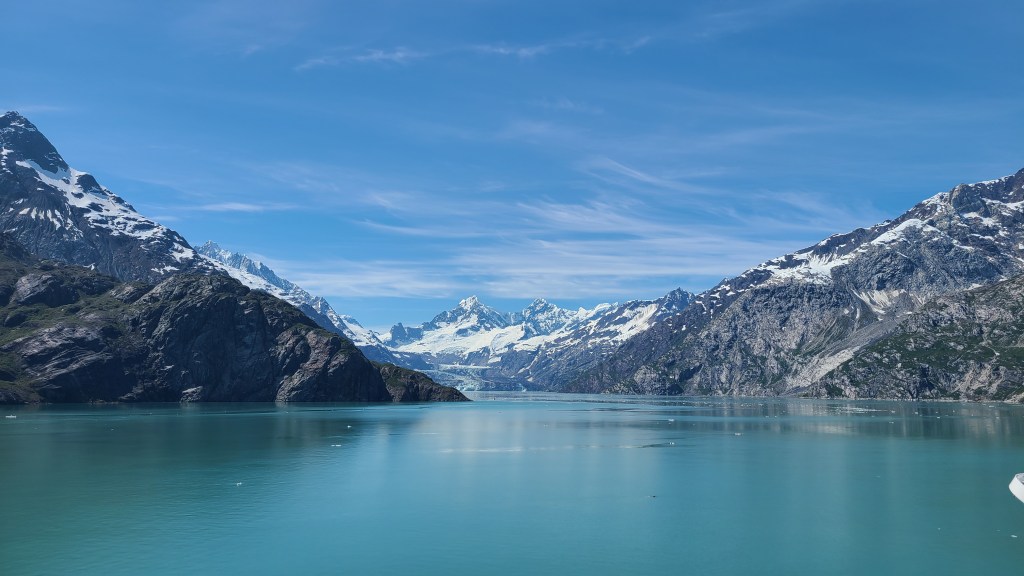
Hang in there, this is a long one that’s only loosely connected to goal setting (seeing bears) but very much connected to writing:
Part 1: Bears, Pursued by Me
Even with the plethora of wildlife viewing options available to us, as my family-in-law prepped for our Alaska cruise, all I wanted to see was bears.
I don’t remember exactly how or why, but my love of bears started with polar when I was young, then, at some point, expanded to all bears. Disney’s Brother Bear definitely had a large influence during my formative years. (In addition to loving the movie and soundtrack in general, I have a vague memory of my dad telling me to take some big sister notes about my behavior toward my own little brothers.) Later, my college mascot ended up being the bears, so I could excitedly count myself among them.
Despite the fact that I’ve visited many a protected green space—national park, state park, wildlife refuge—my batting average for wildlife viewing is abysmal.
So, when I saw one of our excursion options for our stop in Ketchikan was called “Bear encounter by land and sea,” I lobbied hard for it. Nobody was excited about the price tag, so they decided that maybe that would be a good day for every couple to “do their own thing.” Next, I turned to my husband and did my best Puss-in-Boots-from-Shrek impression and promised to never ask for anything ever again if we did this (lie).
Cut to Ketchikan, six months later: We were blessed with a gorgeous day, 70s, sunny, not a cloud in the sky. We were assured more than once that this was abnormal weather for the “Rain Capital of Alaska,” but truly didn’t think much else of it, except for feeling lucky for it.
Our bear encounter excursion started with a bus ride to a dock, then a boat ride to Neets Bay Hatchery with a charismatic tour guide who stood at the front of the boat holding on to no handrails the entire 50 minute ride, talking nonstop about salmon production in Alaska and unbothered by every wave we bounced over.

The hatchery’s main purpose was to rehabilitate the salmon production in southeast Alaska, but they had dipped into the tourism income stream to support their mission. The main thoroughfare that the salmon took to head to the ocean or re-enter the hatchery when it was time to spawn was a beautiful creek in a wooded area. This made it easy for the bear tourists to come grab an easy meal; the viewing platform across from the woods made it easy for human tourists to watch them.
Our group stayed for as long as was possible on that platform in the sun, seeing plenty of salmon and bald eagles. But not a single bear. The hatchery worker who was with us was plenty apologetic, guessing that our furry friends were likely beating the heat by staying in the shade. My wildlife viewing batting average held true, and we didn’t see a single snout peek out from between the trees.
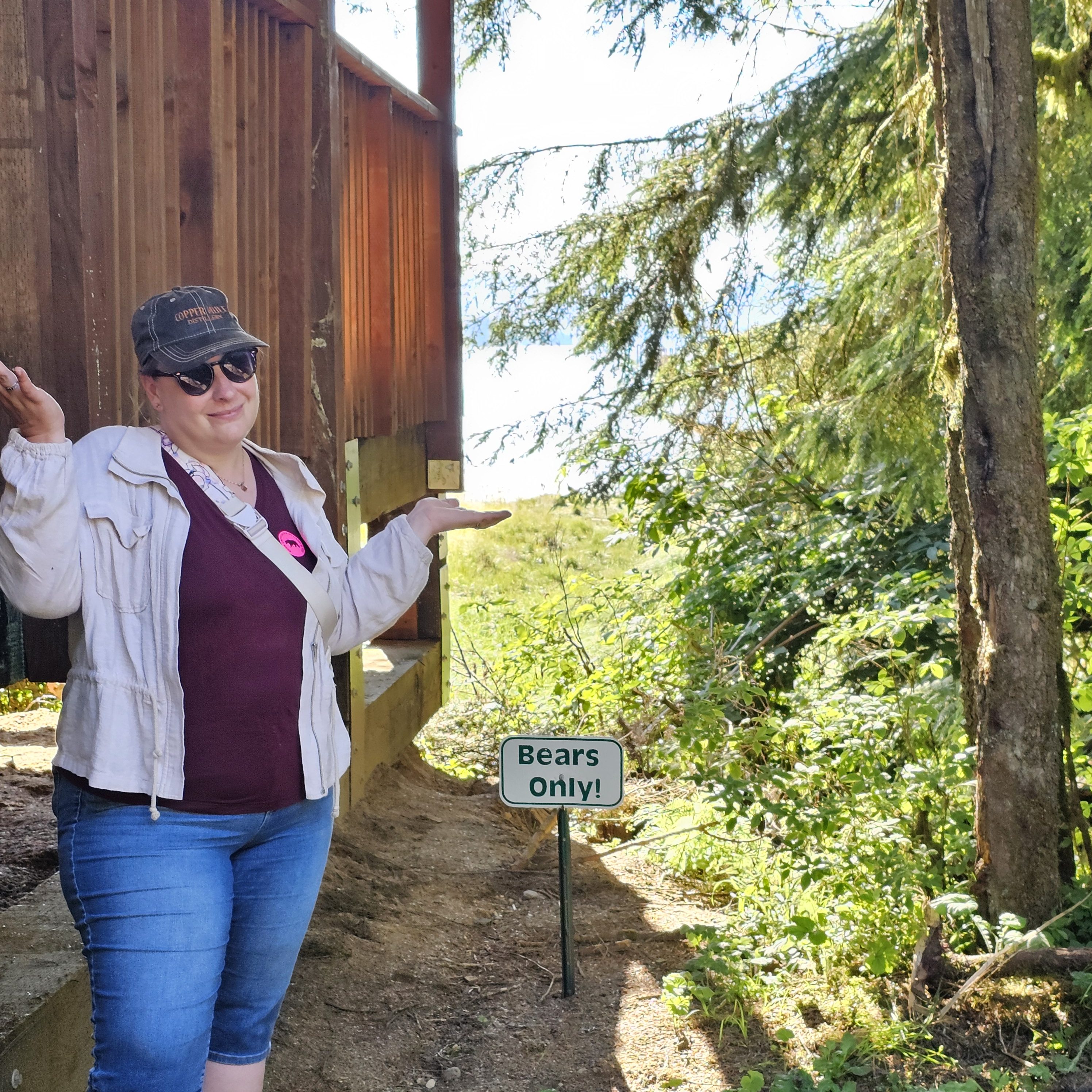
Part 2: When you Can’t Find a Bear, Find a Book
Alas, to this day I still have yet to see a bear. (I even went to Glacier National Park later in the year and still had no luck.) But, I picked up a copy of Eight Bears by Gloria Dickie at the Ketchikan independent bookstore Parnassus Books, and, unlike my “bear encounter by land and sea,” this couldn’t have been less of a disappointment.
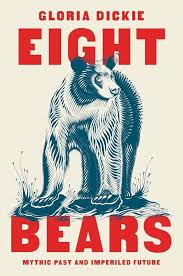
Dickie writes some of the most beautiful sentences I’ve ever had the pleasure of reading. Her word choice is *chef’s kiss* in every single line as she chronicles the fate of the world’s eight bear species: spectacled bears, sloth bears, panda bears, moon bears, sun bears, black bears, brown bears, and polar bears. For someone desperate to see a bear outside of a zoo, her writing made me feel like I was just over her shoulder, traveling the world in pursuit of bears, experiencing the highs and lows of her encounters, or lack thereof, too.
This is a book well worth anyone’s time in sitting down with. Both science writing enthusiasts and armchair travel enthusiasts will get a lot out of Dickie’s journalistic rigor that feeds her gorgeous prose about the animals themselves as well as the people who live with them, manage them, or love them. You gotta love a book where you learn a lot and enjoy the teaching!
Dickie sadly has no other books out at the moment, but she will forever be an auto-buy author for me. She does list her many articles on her website and some of them are free to read. But I’m already looking forward to the next longform adventure she wants to take her readers on.
I rate this one 10/5 bears 🐻!
Part 3: Here’s the Beary Good Writing I Promised
I don’t usually just pull quotes out of context for book reviewing, but I just love the way Gloria Dickie writes so much. Below is a list of my favorite quotes and why. And this is the culled list, I promise! There were so many more. Will this help me with my writing ever? Hope so, I’d love to write like this someday. But, in the meantime, we love to read a master at work!
On the spectacled bear:
“The distance between Cusco and the cloud forest wasn’t far—no more than 40 miles as the quetzal flies—but the journey in a crowded van from the city center took nearly five hours on a vertiginous dirt road through the Andes.” – 22
Why: Quetzal instead of crow is a cheeky replacement in a common saying that helps solidify the South American setting. Then, Dickie could have easily said, “but the journey in a crowded van from the city center took nearly five hours. I was green with nausea the whole time,” but instead more concisely describes the road itself as “vertiginous,” invoking the same feeling in fewer words as well as both the sense of vertigo you get from great heights and the dizziness you feel when you’re car sick. Bravo.
“I pictured Paddington standing in his neat blue duffle coat and floppy red hat on the railway platform. Before his death in 2017, Michael Bond told the Guardian that he was inspired to create the bear after seeing evacuated children trudging through Reading Station during World War II as bombs battered Europe. Each carried only a small suitcase of their most treasured possessions. The children had permanently left behind one world and would soon enter another. “I do think that there’s no sadder sight than refugees,” Bond had said. I thought of the spectacled bear resting on an untidy shelf of sticks up in the cloud forest canopy. I thought of the vanishing clouds. I thought of the mining explosions ricocheting through the bear’s home. In Bond’s hands, the spectacled bear was a parable for the plight of thousands of human refugees and the cost of war. Now the animal was fulfilling Paddington’s fiction. If deforestation continues unabated, the spectacled bear, too, would become a refugee, pushed away from its homeland, never to return.” – 43
Why: Dickie draws a parallel between the violence that made English children refugees in their own country and the violence that is causing the loss of habitat for spectacled bears. While the original creator of Paddington Bear was already using the character to represent these young refugees, Dickie completes the referential circle because Paddington is, himself, a spectacled bear.
On the sloth bear:
“Elephants, tigers, leopards, and rhinos make for uneasy neighbors for millions of people, as do brown bears, moon bears, and sun bears. (India contains more of the world’s bear species than any other nation.) Still, the sloth bear is uniquely aggressive in this toothsome menagerie.” – 50
Why: Dickie successfully conveys just how dangerous the sloth bear is amidst all of its neighbors by highlighting the sheer number of teeth surrounding the bear (who also has terrifying claws). She could have easily said, “Still, the sloth bear is uniquely aggressive due to the size of its claws, while its fellows are more known for their teeth.” “Toothsome menagerie” is a delightfully concise summary of this idea.
On the panda bear:
“And I wasn’t sure why the captive pandas couldn’t do the job themselves—or why so many foreigners had volunteered to break the bamboo into fragments on the bears’ behalf. I could only guess that our pledged labor prevented the panda from exerting too much energy and keeling over into extinction.” – 79
Why: Pandas are notorious for their laziness as well as their endangered status. The picture of a giant panda falling uncaring into extinction because it takes too much effort to live just simply made me laugh out loud.
“The Yangtze River coils around rice terraces like a muddied serpent and cuts through valleys where men and women carry baskets brimming with fiery Sichuan peppers, a potent elixir halfway between spice and numbing novocaine.” – 81
Why: A coiling river gives you the perfect picture of the shape and movement of the river, while describing a pepper as an analgesic gives you a taste of what eating one of them would be like.
“And while the bear may not rank among the pig, snake, goat, and monkey in marking the passage of time, in China, every year is the year of the panda.” – 103
Why: This concluding sentence sums up Dickie’s chapter on the inconsistent political energy that surrounds panda management in China. For example, the country takes great pride in the panda as a national symbol, yet it remains conspicuously absent from the Chinese horoscope.
On the sun and moon bears:
“Rather than chain the animal up, he raised the cub in a ‘nursery with the children; and, when admitted to my table, as was frequently the case, gave a proof of his taste by refusing to eat any fruit but mangosteens, or to drink any wine by Champaign,’ Raffles wrote. ‘The only time I knew him to be out of humour was on occasion when no Champaign was forth-coming.’ Oh, to have been a bear in Rafffles’s time.” – 114
Why: Even while quoting primary sources, Dickie gives us a chance to laugh during some sad chapters.
“Her impossibly long tongue lolled out of her mouth like a fruit roll-up.” – 130
Why: We love a simile that makes it so you can picture exactly what is happening. We have all unrolled a fruit roll-up in our time (as has this bear)!
On the black bear:
“This sharp increase in black bear numbers combined with rampant human encroachment has given rise to a new breed of bear in America: the urban bear.” – 138
Why: Dickie uses a collection of wonderful adjectives to describe the black bear and its new status as a trash seeker thanks to its human neighbors: urban bear, cosmopolitan bear, townie bear, alleyway bear.
“When I’d used the term ‘bear-proof bin’ in my early days of reporting on garbage management, the wildlife manager had swiftly corrected me: almost nothing in the world is bear-proof when confronted with a determined bruin.” – 144
Why: I think of this line all the time whenever I come across a supposed “bear-proof” trash can in my adventures and think of a determined bruin puzzling out how to open it. (And sometimes even I don’t feel smarter than a bear when it comes to opening one.)
On the brown bear:
“Americans, whether through taxes or donations, spent millions of dollars to restore grizzlies—financing habitat protection, private land easements, and educational programs to teach people how to live with an animal capable of eating them.” – 166
Why: Dickie is demonstrating the many complexities of the relationship Americans have with their bears in this succinct sentence.
On the polar bear:
“Out here, one had to be adept at discriminating between shades of white: porcelain, bone white, eggshell, milky white, pearl.” – 185
Why: It’s sentences like these that help transport me to wherever Dickie is at. I can easily imagine a white landscape that is still somehow filled with color.
“Many Inuit even purport that the population is growing and that there are too many bears roaming the Arctic. But the species is heading toward an inevitable cliff: the point on a population chart where the red line chugging along uninterrupted suddenly nose-dives and disappears entirely below the x-axis, submerged much like the polar bear in an ice-free ocean.” – 187
Why: I love this visualization of the dangers of believing that the polar bear population is safe. No ice for polar bears means drowning when there’s finally nowhere to make land.
“Our relationship to the polar bear is one of abstracted interaction, not only in conception, but in how we are driving it to extinction.” – 194
Why: Unlike the brown bears, where Americans are so distinctly aware of them that we directly financially provide for their safety and rehabilitation, polar bears feel more abstract, as do the actions we take (or not) to preserve them, such as mitigating climate change.
“And the brown bears will follow this greened path toward the pole, much as they did hundreds of thousands of years ago when they first sought refuge by the sea. Yet the sea, now void of ice and seal, will not alter them.” – 210
Why: Dickie explains that brown bears are moving north and are already mating with the polar bears. However, instead of how polar bears were created by their first migration north (shaped by the landscape and diet), the brown bear gene will take over and will make polar bears eventually extinct. Dickie’s writing here is as melancholy as the thought.
In conclusion:
“Indeed, the future itself reads much like a fairy tale: The Three Bears. If we fail to make room for bears, we will solidify a future where many of the world’s bears exist only behind glass. Losing bears would mean we lose a beautiful and complex relationship that has paralleled our own journey in this world. We would lose a grandfather, an uncle, a mother, a medicine man, and a teacher. And in some ways, we would lose a part of our own wildness. Without bears, the woods, and our stories, would be empty.” – 214
Why: In Brother Bear (yeah, sorry, I bet you thought you had escaped any more references to it), Kenai receives the bear totem as a symbol of love. Love is the beginning of connection, with each other and with the planet. Dickie says here, beautifully, that our histories and traditions are filled with bears who still may have much to teach us. But if we don’t love bears back, we may lose them.
And maybe that’s part of my goal to see a bear in the wild: As Dickie says, to know that we haven’t lost the wild in our woods yet and there’s still time to preserve it. And, as Brother Bear says, to understand that love (of bears, yes, but also the whole planet) is the place to start.
If you’ve made it this far, thank you for sticking with me! Share below a book or piece of writing that you’ve loved that maybe hasn’t necessarily been about writing but has inspired your craft nonetheless.
–
Dickie, Gloria. Eight Bears: Mythic Past and Imperiled Future. W.W. Norton & Company, 2023.


Leave a Reply